
Here are some good posts on ministry:
Self-Promotion and Our Fear of Obscurity – Joseph Tennry (DG)
Shepherd Your Flock, Not the Flock You Wish You Had – Jared Wilson (Crossway)
Many and Colorful – Tim Challies
Here are some good posts on ministry:
Self-Promotion and Our Fear of Obscurity – Joseph Tennry (DG)
Shepherd Your Flock, Not the Flock You Wish You Had – Jared Wilson (Crossway)
Many and Colorful – Tim Challies
In Isaiah 35, God gives us six joyful blessings for the future:
And how should we respond to these joyful future blessing?
We should be strong (v3-4). Looking at these joyful blessings should give us strength for today. These blessings should strengthen our weak hands, make firm our feeble knees, and give courage to our anxious hearts. In the midst of all of our struggles, there is a light at the end of the tunnel. Our path may take us through dark valleys, but it leads to a joyful end. So be strong.
We should be saved (v8-10). The unclean will not experience these blessings (v8). Only the redeemed, the ransomed of the Lord will know this glorious future (v9-10). So let us embrace the redemption that is found in Jesus. On the cross he paid the debt of our sins; he bore the judgment we deserve for our sins. Instead of judgment, we can know these joyful blessings if we simply look to Jesus. So be saved.
We should share with others. How could we keep these blessings to ourselves? Let’s encourage one another with this glorious hope that we have. And let’s tell others about Jesus and his promises that they too might receive Jesus and one day experience these blessings too.
Manistee River in northwest Michigan
The heavens declare the glory of God,
and the sky above proclaims his handiwork.
– Psalm 19:1
For his invisible attributes, namely, his eternal power and divine nature,
have been clearly perceived, ever since the creation of the world,
in the things that have been made. So they are without excuse.
– Romans 1:20
Here are some good posts for your weekend reading:
God’s School of Waiting – Jeff Robinson (TGC)
You Might Be An Idolater If… – Stephen Altrogge (Crossway)
7 Marks of a Deeply Deadly Sin – Tim Challies (from John Owen)
20 Ways to be Refreshing in the Local Church – Jason Helopoulos
Hope you have a great Lord’s Day with your local church!
We must honor God not only by our loyalty (first commandment) and thought-life (second commandment) and words (third commandment), but also by our use of time, in a rhythm of toil and rest; six days for work crowned by one day for worship. God’s claim on our Sabbaths reminds us that all our time is his gift, to be given back to him and used for him.
– J. I. Packer in Growing in Christ
In Exodus 20, the fourth commandment required Israel to take a Sabbath rest on the seventh day of each week. This pattern was established by God as he rested on the seventh day from his work of creation. And so while the command is indeed part of the Mosaic Covenant, it is also a pattern built into the very framework of creation.
In Deuteronomy 5, a different reason was given for keeping the Sabbath. God reminded them that they were slaves in Egypt, but God had saved them out of their slavery. And so everyone (even the animals!) ought to enjoy and celebrate this new freedom by resting on the Sabbath. Here was a great blessing for everyone to enjoy!
And yet, by Jesus’ day, the Sabbath had become a burden with a myriad of man-made rules attached to it. And so Jesus teaches us further about the Sabbath in Matthew 12:5-14. He makes clear that acts of ministry (like priests offering sacrifices) can be part of the Sabbath. He demonstrates that acts of mercy (like Jesus healing people) can be part of observing the Sabbath. And acts of necessity (like getting a sheep out of a pit) are also acceptable on the Sabbath. In other words, while it is a day of rest and worship, we can do good things for other people (and animals) on this day. Again it was to be a day of blessing!
Many Christians these day have lost sight of the Sabbath, and so have lost out on a great blessing. Some Christians argue that this command is only for Israel, and has no place today. Some claim that since this command is not repeated in the New Testament, that it is not applicable to us. But here in Matthew 12, and indeed scattered throughout the gospels, we find Jesus teaching about the Sabbath. Apparently the gospel writers believed Christians needed to be instructed on the Sabbath. If it does not apply to us, why include it in the gospels when there is so much Jesus must have said and did that we know nothing about?
And in Matthew 12, we are told that Jesus is the lord of the Sabbath. The Lord we follow is lord of the Sabbath, which strongly suggests we ought to follow him in keeping it. And in Mark 2:27, we are told that the Sabbath was made for man – again it is a blessing designed for people!
While the Sabbath command remains, its application changes under the New Covenant. Because Jesus rose from the dead on the first day of the week, the church quickly started meeting for worship on that day (Acts 20:7, I Corinthians 16:2) instead of the seventh day. Instead of remembering creation and salvation from Egypt, now we remember Jesus’ work of re-creation and salvation from sins through the cross and resurrection. And so the early church celebrated our salvation through the Lord’s Supper (Acts 20:7), did acts of ministry like teaching (Acts 20:7), and also acts of mercy like giving (I Corinthians 16:2) – all on the first day of the week.
My purpose here is not only to encourage you to rethink the fourth commandment’s application for today, but even more to encourage you to consider what a blessing it would be for all of us to follow it whether it is required or not.
The Sabbath is a command, but it is also a gift. A day of worship and rest. A day of delight and joy.
A day of blessing.
What does the fourth commandment mean for the Christian? Like the Israelites, we are made in the image of a working, resting God. We still need to work, we still need to rest, and we can still receive the creation blessing of God’s holy day.
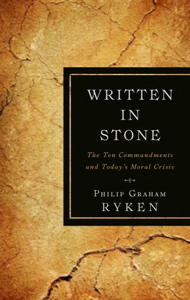
– Philip Graham Ryken in Written in Stone
– Charles Spurgeon
The Lord is merciful and gracious,
slow to anger and abounding in steadfast love….
For as high as the heavens are above the earth,
so great is his steadfast love toward those who fear him;
as far as the east is from the west,
so far does he remove our transgressions from us….
But the steadfast love of the Lord is from everlasting to everlasting
on those who fear him….
– Psalm 103:8, 11-12, 17
His love shines forth in his mercy and grace and patience toward us.
His love is higher than the heavens.
His love removes our sin.
His love lasts forever.
To those who fear Him.
Toward His people.
Not because we are great,
But because His love is great.
We are sinners; we are dust.
But he loves us anyway.
God loves us!
Praise God with high exaltation
He is our strength and salvation
Stability in these dark days
We wait and trust your gracious ways
Fear God who reigns in holiness
Come walk with Him in righteousness
Do what is good – speak uprightly
Guard what you hear and what you see
Praise God – holy, holy, holy
We’ll see our King in his beauty
He will protect, he will provide
Forgiven we’ll dwell by his side
– From a sermon on Isaiah 33
(To the tune of the “Doxology”)