The Discipline of Giving

The Men’s Discipleship Group at my church went through R. Kent Hughes book, Disciplines of a Godly Man this past year. It was a good study. One discipline Hughes focused on was giving. He calls for a disciplined understanding of giving and a disciplined act of giving.

Disciplined Understanding of Giving

  • Giving is not a meritorious work.
  • Giving does bring blessing.
  • Giving which pleases God is generous and sacrificial.
  • Giving should never be decided casually or flippantly, but through serious prayer.

Disciplined Act of Giving

  • The act of giving should be accompanied by offering oneself to the Lord.
  • Everyone should at least consider the first 10 percent as a starting point in giving – a minimum.
  • Your giving ought to be regular.
  • You must begin giving now.
  • Giving should not only be regular, but responsive to need, spontaneous.
  • Your giving should be joyous.

The Test

Summer is here.  And with summer comes numerous activities that compete for our time.  And some of those activities are on Sunday mornings, competing for our time with the Lord and his people.  It may be a game, a race, a family get-together, a trip to the beach, a work picnic, or any number of other things.  Each alternative Sunday morning activity represents a test.

  • It is a test of our priorities.  Will we choose what Christ offers or what the world offers?  Will we choose Christ or that activity?  Which will be first?  Which will take the priority?  The early church devoted themselves to coming together for the Word and prayer.  Paul risked his life to plant and build up local churches.  Will we share their commitment?  Our world is filled with idols that many people worship, but on Sunday mornings the church gathers to declare that there is one true God.  We gather to celebrate the gospel of Jesus Christ.  We gather together to worship the King of Kings and Lord of Lords.  What could possibly be more important than that?
  • It is a test of our attitude.  We could come every Sunday to church, but with the wrong attitude.  We could come bitter because we really want to be doing something else.  We could sit through the sermon impatiently, hoping it will end soon so we can go and do what we really want to do.  Or we could gather expectantly, excited to see what God might do among us.  We could gather joyfully to worship the Lord through singing and prayer and His Word.  What is our attitude?
  • It is a test of our witness.  Like it or not, church is a public expression of our commitment to Christ.  Our neighbors see if we leave for church each week.  Our families see if we are committed or not.  If we don’t have a strong commitment to church, it communicates to others that Christ really isn’t that important to us.  And if it isn’t important to us, why should it be important to them?

So this summer when those alternative activities come up, go to church.  Tell your family you will be late to that family get-together.  Tell your coach you can’t make the game.  Save that trip to the beach for another time.  You already have plans for Sunday morning.  You have a prior commitment.  Make church a priority, with a good attitude, as a good witness for Jesus.

Sandcastles

Fam2012 226

My family found an incredible sand castle on the beach this past summer.  By the time we had left, we had added on to it, making it even bigger.  Making sandcastles can be a fun activity on the beach, but eventually the waves or rain will wash them away.  What is fun on the beach is tragic in life.  Too many people build their lives on things that won’t stand the test of time.  They waste their life building sandcastles that won’t last.

Many people build their lives on their own feelings or desires.  Rather than build their lives on what God says has eternal value, they build their lives on what they want to do in the moment.  They waste their lives building sandcastles that won’t last.

Other people build their lives on things.  They live to get more – as much stuff as they can.  They lay up for themselves treasures on earth that will rust or rot or break instead of laying up treasures in heaven.  They waste their lives building sandcastles that won’t last.

Still others build their lives around fame or popularity.  Perhaps it lasts for awhile, but then it’s gone.  It is fleeting.  And it has no eternal value.  They waste their lives building sandcastles that won’t last.

There are many ways to build our lives around things that won’t last, to waste our lives building sandcastles.  But Jesus calls us to lay up treasures in heaven.  He bids us seek first the kingdom of God and his righteousness.  He calls us to love God with all of our being, and to love the people around us.  He bids us to live our lives for his glory instead of our own.

What sandcastles are you building?  Isn’t it time you started building something with more substance, something that will stand the test of time?

God’s Math Works Differently

Jesus looked up and saw the rich putting their gifts into the offering box, and he saw a poor widow put in two small copper coins. And he said, “Truly, I tell you, this poor widow has put in more than all of them. For they all contributed out of their abundance, but she out of her poverty put in all she had to live on.”
 – Luke 21:1-4

God’s math works differently than ours.  According to human math, the rich are obviously giving more.  But according to God’s math, it is the widow who gives more.  Consider further what God’s math looks like:

We never earn too little to give.  The poor widow is unable to earn hardly any money, yet she gives.  Human math may tell us we earn too little and discourage us from giving.  But the widow frees us from seeing only through human eyes.  She helps us see through God’s eyes.  If she can give, then so can we.

God doesn’t despise small gifts.  The rich are giving great sums of money.  Human math would say that the widow’s gift is insignificant.  God’s math says she gives more than all the others.  We might despise her gift, but God values it.  And he can use it.  Human math may tell us our gift is too small.  But God values and uses small gifts.  What an encouragement for us!

God is more interested in percentages than amounts.  The rich are giving much money, but a small percentage.  The widow gives only two small coins but a hundred percent.  Human math says the rich gave more.  God’s math says the widow gave more.  God sees the percentage.  We may not have a large amount to give, but everyone can give a percentage.  How encouraging!

God looks at the heart more than the gift.  The widow doesn’t have to give, but she wants to give.  Human math only sees the money, but God’s math cares more about the heart.  What moves our hearts to give?  The widow’s gift occurs during the week before Christ’s death for us.  The widow could be seen as a type of Christ who became poor to give all that he had – his very life for us.  The more we grasp his sacrificial gift, the more we will desire to sacrificially give to him.

The real issue isn’t giving, it’s trust.  In giving all she has, the widow must trust in God to take care of her.  One reason people struggle to give is that they trust in their money more than in God to take care of them.  They follow human math, and forget God’s math.  If we don’t trust God, we won’t give until we have more than we need.  But God is well able to take care of us.

Christ’s return should motivate us to give.  After observing the widow, Jesus begins to predict his return.  We can invest our money in trinkets that will mean nothing when Christ returns, or we can invest our money in the kingdom that will last forever.  Human math sees only this world.  God’s math looks to eternity. 

We can live like the rest of world using merely human math, or we can begin to see the world using God’s math.  May God help us to see as he does.

Mine!

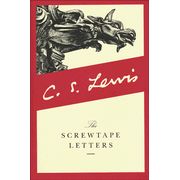
I just finished re-reading The Screwtape Letters by C.S. Lewis.  In one letter, the senior devil Screwtape instructs his subordinate Wormwood to encourage his “temptee” to have a sense of ownership.  He writes:

The sense of ownership in general is always to be encouraged.  The humans are always putting up claims to ownership which sound equally funny in Heaven and in Hell, and we must keep them doing so.

Screwtape discusses our sense of ownership of time.  We think and act like time is our own.  If someone or something intrudes on our time, we tend to get upset.  And yet Screwtape notes the reality that the time we have is clearly not ours.  God gives us so many hours to use.  It is not our time.  It is God’s time.  We are only stewards. 

As we think about this issue, we can go further.  We also seek to own things.  But “the earth is the Lord’s and the fullness thereof” (Psalm 24:1a).  Certainly in one sense we can own things, in that something may belong to me as opposed to you.  But in the greater scheme, it all belongs to God.  They are God’s things.  We are only stewards.

We seek to own our own bodies.  And certainly in one sense my body belongs to me; it is part of me.  But in another sense: “You are not your own, for you were bought with a price.  So glorify God in your body” (I Corinthians 6:19b-20).  By rights of creation and salvation, my body belongs to God.  Indeed all of me – my mind, my abilities, all of me belongs to God.  We are only stewards.

We seek to own people.  Not in the sense of slaves exactly, but in the sense of control.  But again, people belong to God, not us.  And here perhaps we come to the issue behind our desire to own things.  We want to control them.  If it is mine, I have the right to do what I want with it.  I can use my time, my stuff, my body, my family, my employees, my __________ in whatever way I choose.  And so we sin against God and people because we have bought into the deception that I have the right to act as I do because they are mine to do with as I please.  But if it all belongs to God?  The truth sets us free to be good stewards of our time, things, and bodies.  It sets us free to treat people as God’s image-bearers rather than our puppets.  It redirects all of life toward God. 

May God help us overcome the temptations and temptors that encourage us to cry out, “Mine!”  And may we look to the One who can truly claim ownership of all creation.

Health To Serve

And he arose and left the synagogue and entered Simon’s house. Now Simon’s mother-in-law was ill with a high fever, and they appealed to him on her behalf. And he stood over her and rebuked the fever, and it left her, and immediately she rose and began to serve them.
– Luke 4:38-39

Simon’s mother-in-law was sick, unable to serve.  Then Jesus healed her, and as soon as she was well, she began to serve.  She used her new health to serve Jesus. 

Has God given you health in this period of your life?  If so, what are you doing with it?  Are you using it to serve Jesus?

Perhaps your health is limited.  Are you using what health you have to serve Jesus?

Don’t waste your health.  Use it to serve the Lord.


Resolution Questions

As I mentioned in the last post, I take time at the new year to evaluate where I am and where I would like to go in the coming year.  In examining my life, and considering how I need to grow, it is helpful to have some good questions to ponder.  Donald Whitney has given us 31 great questions to consider at the beginning of a new year.  A sampling includes:

  • What’s one thing you could do this year to increase your enjoyment of God?
  • What’s the single most important thing you could do to improve the quality of your family life this year?
  • In what spiritual discipline do you most want to make progress this year, and what will you do about it?
  • What is the single biggest time-waster in your life, and what will you do about it this year?
  • What is the most helpful new way you could strengthen your church?

For all 31 questions, visit his site here.

New Years Resolutions

Every year I make some new years resolutions.  I start by evaluating where I am, and pondering where I would like to be and how I would like to grow.  I then seek to make several resolutions which are broken down into two main categories that follow the theme of this blog and my life.

The first category is “To live with a passion for God and compassion for people.”  Under this category, I have the the following sub-points:

  • By setting my gaze on Christ and spending time with God as his loving child
  • By spending time with my family as a loving husband and father
  • By spending time with others
  • By focusing on Christ’s passion for me (salvation)
  • By living out the commands of love (10 commandments)
  • By living out the virtues of love (Fruit of the Spirit plus others)
  • By practicing the habits of love (spiritual disciplines)

Each sub-point then has a few specific resolutions that I want to live out during the coming year.  Some will be new; others will simply be something I want to continue or improve.

The second category is “To help people and families live with a passion for God and compassion for people.”  Again there are subpoints with specific resolutions under each.  My subpoints are:

  • By discipling my own family
  • By serving in my local church
  • By writing resources for individuals, families, and churches
  • By teaching in various settings as opportunities arise
  • By pursuing continued learning opportunities

I share all of this to perhaps encourage you to evaluate your life, and consider how you might better live and help others live with a passion for God and compassion for people.  Your subpoints may look very different (especially in the second category), and your resolutions will likely be very different (you’ll notice I didn’t even include them), but the point is to evaluate where you are and where you might grow.

A few final thoughts.  First, it is easy to go through all of this and then put your resolutions away and forget them.  I’ve done this.  Don’t do this!  Keep them out where you can see them and review them regularly.

Second, my two categories and their subpoints are very general – the resolutions themselves must be specific so you know if you are accomplishing anything.  At the same time, leave room for adjustments and changes during the year.  Some ideas simply might not work.  God may call you in different directions than you had planned.  Feel free to edit your resolutions during the year.

Third,  don’t bite off more than you chew.  I have a lot of subpoints, but many of my resolutions are to simply to continue what I am doing or change my focus a bit.  Only a few resolutions will be really new.

Finally,  bathe the entire process in prayer and keep praying through it during the year.  It is only be God’s grace that we can grow, so come regularly to the throne of grace to find his grace in your need to grow.

May we grow this year in living and helping others live with a passion for God and compassion for people – because of Christ’s incredible passion for us!

Media Madness

We are surrounded by media – TV, movies, radio, music, internet, books, magazines, newspapers, mail, the list goes on.  We are bombarded with media.  Its presence and influence is pervasive; it is everywhere.

Jesus died on a cross and rose again that our sins might be forgiven, that we might be reconciled to God, that we might have a new life in Christ, and the hope of heaven and the resurrection.

How does Christ’s salvation relate to the media?  How should what Christ has done for us affect the way we interact with the media that is all around us?  The book of Ephesians gives us the answer.

The first half of the book speaks of Christ’s salvation.  God chose us to be holy and blameless before him (1:4).  Through Christ, our sins are forgiven, and we have a great inheritance (1:7, 11).  We were dead in our sins following the evil tendencies of a world opposed to God, but God has made us alive in Christ to do good works.  All of these blessings come by God’s mercy, grace, and love as we receive this salvation from sins by faith (2:1-10).  And this salvation is available to all of us (2:11-3:13).

This great salvation then ought to affect the way we live (4:1).  It should affect how we interact in the church (chapter 4), in our culture (5:1-20), in our families (5:22-6:4), and in the workplaces (6:5-9).  As media is such a pervasive part of our culture, the words in Ephesians 5:1-20 can easily be applied to how we interact with the media.  So we find four principles:

1. Guard your heart.  Verse 2 tells us to love as Christ loved us and gave himself as a sacrifice to God.  Christ loved God and us, and we should love that way too.  But it is possible for us to come to love the media – to put it before God and the people around us.  In other words it can become a god, an idol.  It can dominate us, control us – we have to have that new book, we have to see that new movie.  We become puppets, and the media pulls our strings.  Guard your heart, don’t let the media become your god.

2. Use discernment.  Verses 3-10 point us here.  Verse 10 tells us to discern what is pleasing to God.  So we need to ask, does this media choice please God.  If not, don’t watch/listen to/read it.  Verse 3 points to the sex issue.  Does this media cause you to lust (impurity)?  Does this media celebrate sexual immorality – that which God will judge (v6)?  If so, turn it off, get rid of it, walk out.  Verse 4 points to the language issue.  Again, does this media engage in that which God will judge, that which we should not even associate with (v7)?  This may rule out most sitcoms, late night shows, and many movies (even kid movies!), but again is our goal to live for media or God?

There is a wonderful phrase in Latin that Craig Cabaniss mentions in his chapter on media in the book Worldliness, edited by C.J. Mahaney.  The phrase is Coram Deo – “before the face of God.”  Everything we do is done in God’s presence.  Is it pleasing to him?  If Jesus walked this earth today, would you invite him to watch that movie, listen to that music, surf that site, read that book?  The fact is, he is with you as you do all those things.  Is it pleasing to him?

In Psalm 101:3, the psalmist says, “”I will not set before my eyes anything that is worthless.”  Have you made that commitment?  Is your goal to please God?  Use discernment.

Before moving on, we need to consider the message in a particular media choice.  Romans 12:2 warns us not to be conformed to the world – that is, the evil tendencies of a world opposed to God.  Does this media choice conform me to the world’s way of thinking.  Is it teaching truth or lies?  There is a grave danger here.  We are tempted to focus on language, sex, etc., but “clean” movies without those things can teach lies, can oppose God and his Word.  And this includes Christian media.  We need to think critically whenever we come to the media.  What is the message?  Does it agree with Scripture?  Use discernment.

3. Practice good stewardship.  Verses 15-16 tell us to make the best use of our time.  Is this media choice the best use of my time right now?  Am I spending too much time with a particular type of media?  Is there something else I should be doing?  Even if our media passes the discernment test, we can spend too much time in front of the TV, on the internet, etc.  We can neglect family, friends, time with God, outdoor recreation.  Practice good stewardship.

4.  Finally, enjoy gratefully.  Verse 20 calls us to give thanks for everything.  Cabaniss ends his chapter on media with this point, and it is a good one.  If our media choice passes the discernment and stewardship and heart principles, then we can enjoy it gratefully.  The other three principles remind us of the dangers of media; this point reminds us that there is a lot of good media out there that we can enjoy and give thanks to God for.

Christ purchased for us a great salvation that should affect the way we live in our culture, how we interact with the media.  Guard your heart.  Use discernment.  Practice good stewardship.  Enjoy gratefully.

Learning To Share

Here is an interesting thought to ponder: we try to teach our children to share – all the time doing the best we can to own everything we need so we never have to share.  A bit inconsistent, isn’t it?

We have bought into the idea that we have to own everything we use.  Our homes, garages, and (where I live) polebarns are full of things we seldom use, but nevertheless bought sometime along the way.  Now we have to store all the stuff that is just rusting or rotting where it sits.  Except for the polebarn, I share in this tendency.

What about an alternative?  It is interesting that the early church held everything in common – that is they shared things.  Take the example of a roto-tiller.  I’m told they cost about $1000.  How often do you use a roto-tiller?  Once or twice a year?  So all kinds of people have roto-tillers rusting in their sheds 363 days a year.  Now suppose four families decided to buy a roto-tiller to share.  Instead of forking over $1000, they only have to fork over $250.  That is a significant savings – especially in our current economy.

If our eceonomy continues to deteriorate, we may be forced to start thinking this way just to survive.  And if our economy improves?  What if we still started learning to share anyway.  In the roto-tiller example – there is an overall savings of $3000.  Now suppose that savings was used to support missionaries trying to get to the field or to feed hungry children in another country.  Sharing and then giving the savings could help us advance the kingdom.  We need to start thinking more strategically and creatively about the resources God gives us.

Bottom line: We can store up treasures on earth that we rarely use or we can learn to share and store up treasures in heaven.   I think Jesus said something like that once….