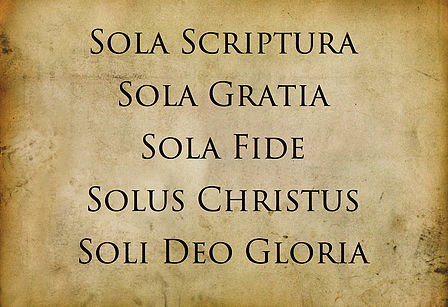

Reflecting on the Five Solas

fivesolas

Sola Scriptura – Scripture Alone

But as for you, continue in what you have learned and have firmly believed, knowing from whom you learned it and how from childhood you have been acquainted with the sacred writings, which are able to make you wise for salvation through faith in Christ Jesus. All Scripture is breathed out by God and profitable for teaching, for reproof, for correction, and for training in righteousness, that the man of God may be complete, equipped or every good work. – II Timothy 3:17-17 (ESV)

Your word is a lamp to my feet and a light to my path. – Psalm 119:105 (ESV)

Questions for Reflection
Where do we learn about salvation?
What should be our guide?
Are you committed to reading God’s Word?
Does God’s Word govern your life?
What other authorities are you tempted to follow instead of God’s Word?

The Theme of Revelation

Theme: Behold the Coming of Our Triumphant King

Behold: Behold the visions John saw and recorded.
Coming: Jesus is coming soon.  Even so, come, Lord Jesus!
King: Jesus reigns as king over all.
Triumphant King: Jesus will defeat all his enemies when he returns.
Our Triumphant King: No matter how bad things look, we are on the winning side.  Because Jesus wins, so will we.

So let us live with courageous hope.  No matter what we face, we can have courage today because we have a sure hope for the future.

So let us live with faithful endurance.  In the face of persecution, temptations, and suffering, let us endure faithfully for our King.

So let us live with awe-filled worship.  We have a great King who is worthy of all praise, glory, and honor, so let us worship him in awe.

Cultivating Your Prayer Life

CultivatePrayerIn How Can I Cultivate Private Prayer, Joel Beeke’s third way to take hold of yourself is to speak with sincerity in prayer.  He notes Psalm 62:8 which calls for us to pour out our heart to God.  We cannot just mouth words; the heart, indeed our whole being, is to be involved.

Beeke expands on this thought by quoting Thomas Brooks:

God looks not at the elegancy of your prayers, to see how neat they are; nor yet at the geometry of your prayers to see how long they are; nor yet at the arithmetic of your prayers, to see how many they are; nor yet at the music of your prayers, nor yet at the sweetness of your voice, nor yet at the logic of your prayers; but at the sincerity of your prayers, how hearty they are.

So how hearty are my prayers?  Am I simply mouthing requests without feeling?  Going through the motions of praying through my prayer list?

Or am I crying out to God for help?  Am I groaning for his intervention?  Pleading for his grace and mercy?  Rejoicing in his blessings?

Where is my heart?  And where is yours?

Cultivating Your Prayer Life

In How Can I Cultivate Private Prayer, Joel Beeke’s second way to take hold of yourself is to maintain the priority of prayer.  He notes Jesus’ commitment to prayer, and then asks:

If the incarnate Son of God needed to pray often to His heavenly Father, then how much more do we need to make prayer a priority in our lives?

So then how much of a priority is prayer in my life?  Do I make time for it?  Even when I’m busy?  Is it the first thing to go in a crunch, or the last?

Do I prioritize time daily for prayer?  Do I prioritize praying together with my church?  For my church?  For my family?  For myself?

CultivatePrayerWhat is it that distracts me from prayer?  What is it that keeps me from prayer?  Are there distractions in my life I need to seriously address to maintain (or even begin to have) the priority of prayer?  Does media eat up too much of my time and crowd out prayer?  What have I prioritized, even without thinking, above communing with God?

I need to rethink my priorities this week, and then make application to my life.  What about you?

Cultivating Your Prayer Life

CultivatePrayerIn How Can I Cultivate Private Prayer, Joel Beeke challenges us to take hold of ourselves in seven ways to cultivate private prayer. His first point for this week is to remember the value of prayer.  He lists five values to prayer (which I will let you read), before focusing on two: the value of finding God in prayer and the value of God answering prayer.

First, no matter what way God may choose to answer our prayers, there is great value in finding God.  Beeke writes:

God is always greater and more valuable than His answers.  The greatest mercy is to find God, not His mercies.

Our time in prayer draws us closer to the Lord as we seek him, cry out to him, and wait upon him.  What a wonderful opportunity we have to find God and commune with him!  What activity could be more valuable?

Second, what a wonderful thing it is to see how God answers prayers.  We have a powerful God who can do all things, and he chooses to work through our prayers.  Think of ways that God has answered prayer in your life, in your family, and in your church.  His answers to our cries make prayer of huge value as He is able to do what only He can do.

We must remember the value of prayer if we would commit to grow in prayer.  We must believe that it is valuable – of highest importance – if we would give greater time and energy toward it.

So let us remember the value of prayer.  And let us cultivate our private prayer accordingly.

Cultivating Your Prayer Life

CultivatePrayerFollowing the introduction, Joel Beeke’s booklet, How Can I Cultivate Private Prayer, has two main calls: “Take Hold of Yourself” and “Take Hold of God.”  Each call has seven principles.  But before we get to them, this week I want to focus on his introduction to the first call to take hold of yourself.  He writes:

I thus plead with you to seek a more fervent and faithful prayer life, with effort, urgency, and dependence on Christ and the Holy Spirit.

I must exert effort if I am going to cultivate my prayer life.  Prayer can be hard work, and pressing forward in this holy habit will require discipline and self-control.  I will not simply drift into a greater prayer life.

I must have a sense of urgency.  There are always other things to do that seem more urgent, that will crowd out this important habit of prayer.  There is always the temptation to put this off to another time when I have more time (whenever that will be).  The only way I will grow in this habit is if I sense an urgency today to make it happen today.

I must depend on God to help me grow in prayer.  I need his grace and his Spirit if I am going to have the self-control to exert the necessary effort (Titus 2:11-12, Galatians 5:22-23).  I must pray even to grow in prayer.  But here surely is a prayer that God delights to answer!

Effort.  Urgency.  Dependence.  May these be true of me – and of you too, as we seek to grow in prayer.

Cultivating Your Prayer Life

Today we continue our way through Joel Beeke’s little booklet, How Can I Cultivate Private Prayer?  On p5, Beeke writes:

Consider the tremendous potential of prayer.  It is nothing less than communion with the living God.

CultivatePrayerI am trying to keep this mind as I pray this week.  I don’t want to just work through a list of needs (though I do want to do that).  I want to commune with God.  I want to recognize who I am talking to, and enjoy being able to talk to my Creator and Sustainer and Savior and King.  I want to rest in the love of my Father as His beloved child as I come before Him.

Through Jesus, we can draw near to God Himself and commune with Him.  What a great blessing to remember and exercise.  May God help us to commune with God this week!


Cultivating Your Prayer Life

CultivatePrayerOur Sunday School class just finished two weeks reviewing the Biblical principles found in Joel Beeke’s booklet, How Can I Cultivate Private Prayer?  I can’t help but think that if I could just digest and apply these principles, that my prayer life, and so my walk with God, would grow in incredible ways.  To that end, I am going to take a section each week to reread, ponder, and seek to apply to my prayer life.

And I want to invite you to join me on this quest for growth.  First, you need the book, which you can order here, or if you have Kindle you can get it here.  Then read along with me each week.  I will have a blog related to the weekly section each Wednesday.  On p2, Joel Beeke writes:

Prayer is a crucial part of the Christian life and deserves our careful attention and cultivation. 

That being so, let’s strive to grow in this important habit.

Beloved

Therefore, be imitators of God, as beloved children.
– Ephesians 5:1

God calls us beloved children.  You are God’s beloved child – his dearly loved son or daughter.  You are dearly loved by God.

The Creator and Sustainer and Sovereign King of the entire universe dearly loves you.  Let that sink in.  God dearly loves you.  Oh that you might grasp this incredible truth that God loves you.  Who cares what others think of you, if God of universe loves you.

This word “beloved” occurs three times in Ephesians.  Once is here.  The first time was back in 1:6 where Paul referred to Jesus as the Father’s beloved.  At Jesus’ baptism, the Father declared, “This is my beloved Son in whom I am well-pleased.”  And here in our text, the Father says the same thing to you: “You are my beloved son.  You are my beloved daughter.  You are my beloved child.  I dearly love you.”

You are beloved by God.

May that truth sink into your heart, and may you live each day out of this glorious reality.

Four Ways to Participate in a Baptism Service

Our church baptized three of our young people yesterday.  What a glorious day it was!

Before we did the actual baptisms, I reminded everyone that we were all there to participate in the baptism service.  It was not just for the three being baptized, but we were to all participate in the baptism service.  So here are four ways to participate in your church’s next baptism service.

First, we are all there to celebrate God’s saving work in the lives of those being baptized.  By faith in Jesus Christ, their sins have been washed away.  They are now His disciples.  And they are standing before us to proclaim that reality in their lives.  That is worth celebrating!

Second, we are all there to witness their confession of faith and commitment to follow Christ.  As witnesses, we must then be committed as their church family to help them grow in their walk with the Lord.  We commit to teach, to encourage, to support, to pray for, to build up, to be the church family in which they can grow up in the Faith.

Third, we are all there to remember our own baptisms.  As we watch these new believers be baptized, we remember our public proclamation of faith through the waters of baptism.  We remember our own salvation through Jesus Christ, and our own commitment to live for Him.  And as we remember, we affirm our faith and desire to follow Christ.

Finally, we are all there to pray for any who do not know Christ as their Savior who may be observing the baptisms.  We cry out silently that God might be at work in people’s hearts convicting them of sin and the real offer of salvation in Jesus Christ.  This assumes of course that we are in fact saved.  If not, then we ought to prayerfully consider our own need of salvation, of receiving what those who are being baptized have received.

Don’t just be a spectator at your next baptism service.  Be an active participant as you celebrate, witness, remember, and pray.