
Distracted

Luke 10: 38-42 gives the account of Jesus stopping at Martha and Mary’s home.  Mary is sitting at Jesus’ feet listening.  Meanwhile Martha is distracted in her serving.  It is not the serving which is a problem, but being distracted.  Indeed the text tells us she is not only distracted, but she is distracted by much serving.  Jesus tells her she is anxious and troubled about many things.  Much.  Many.  Busy, busy, busy.  Go, go, go.  Lots to do.   Distracted.

How easily we allow our lives to be filled up with busyness, much, many.  Our lives become frantic, hectic, crazy.  We become impatient, cranky, irritable.  Like Martha we get upset when we see someone just sitting.  All this busyness hurts our relationship with God.  It hurts our relationship with people.  We don’t have time for either.  We are distracted.

I can get so distracted by service, by ministry, that I can fail to sit at the feet of Jesus and just listen.  What about you?  What distractes you so much that you fail to sit at the feet of Jesus and just listen?  Maybe it is ministry.  Maybe it is work.  Maybe it is family activities.  Maybe it is a hobby.  What distracts you from Jesus?

It struck me this summer that I am addicted to doing.  I can’t stop.  Even when I sit down to relax, I have to be doing something.  Maybe you can relate.  You can’t relax.  You feel guilty when you stop.  So you just keep going, doing, accomplishing.  You, like me, are distracted.

In all this busyness and distraction, Jesus says there is only one thing necessary.  Some manuscripts say few things are necessary.  Either way, one or few is a long way from much and many.  We will look at that one thing (that is over even a few things) in the next post.  But for now, consider if you are caught up in busyness, if you are so distracted that you fail to sit at the feet of Jesus and just listen.  Maybe like me you need to learn when to stop, how to say no, how to slow down.  Maybe you need to shed some non-essentials from your life.  We don’t have to live our lives distracted.
Web Weekly

Some links to check out for the week:

First, a few more links addressing our problem of individualism.  As Justin Taylor reminds us, it can affect the way we read the Bible.  As John Stott notes, individualism also infects our understanding of salvation and the church.  Against this individualism, Trevin Wax notes one of many reasons that we need the church.

Second, Darrin Patrick addreses the idolatry issue by reminding us that we are all worshippers.   Thabiti Anyabwile gives us great quote from Thomas Watson on the true believer’s desire for Christ.

Third, Tullian Tchividjian reminds us that God calls many to secular jobs which they are to do to the glory of God.  An excerpt:  Martin Luther was once approached by a working man who wanted to know how he could serve the Lord. Luther asked him, “What is your work now?” The man replied, “I’m a shoemaker.”  Much to the cobbler’s surprise, Luther replied, “Then make a good shoe and sell it at a fair price.”  He didn’t tell the man to make “Christian shoes.”   I love that last sentence.  I can see it now:  Shoes with a Christian fish on them – that would make them Christian, right?  Spare us!  Read the rest of the link to think further about secular callings.

Fourth, how do we decide what to do in those so called grey areas?  Justin Taylor gives us eight helpful questions to ask to help us answer the grey area question.

Fifth, J. D. Greear gives a thought-provoking post on how generosity and the gospel necessarily relate.

Finally, consider Trevin Wax’s helpful prayer for humility.

Love Your Neighbor

The Bible teaches us to love our neighbor.  But who is our neighbor?  This is a question a religious expert asked Jesus in Luke 10, and Jesus responds by telling the parable of the Good Samaritan.  Most are probably familiar with this story.  A Jewish man is attacked by robbers and left half-dead on the side of the road.  Two religious leaders come along, and both keep right on going.  Finally Jesus introduces the Samaritan.  His Jewish listeners immediately assume he won’t help.  Jews and Samaritans hated each other.  But Jesus has the Samaritan stop, bind up the man’s wounds, bring him to an inn to recover, and pay for all the expenses.  The point is obvious:  Your neighbor includes those who oppose you, who hate you, who you want to hate.  Loving your neighbor means you love even your enemies.  And loving your neighbor means you help him when you see a need you can meet.

But let us go back to Jesus and his listeners.  The atmosphere is electric.  The listeners are bristling.  The Samaritan is the hero?  How dare Jesus make a Samaritan the hero!  Samaritans are half-breeds.  They don’t worship right.  There has been hatred and opposition between the two groups for year, and Jesus makes the Samaritan the hero?  Jesus is clearly not a good politician, because his popularity level drops significantly here. 

Why does Jesus tell the story this way?  He could have made it a Samaritan who is hurt and a Jew who saves the day.  His main point to love your enemies would have remained intact.  And he wouldn’t have offended his listeners.  Why does he make the Samaritan the hero?  Is he trying to get their attention?  Does he want to irritate them?  Let me suggest another possibility.

I think Jesus is trying to remind them that even their enemies are capable of doing good because they are made in the image of God.  We want to villianize our enemies.  We seek to demonize those who oppose us.  If we can paint them as evil, then we can treat them as evil.  But wait, they are still people made in God’s image capable of doing good.

Let’s retell the story for today.  Jesus is invited to a Tea Party.  He goes and begins to tell this story:  A man affliated with the Tea Party is driving down the road in his car emblazoned with Tea Party slogans.  His car stalls, and as he gets out to see what is wrong, he collapses.  A Tea Party leader comes along, sees the man on the side of the road, and zooms right on by.  A Tea Party organizer sees the man and zooms right on by.  Then a Democrat sees the man, stops, calls 911, calls the tow truck, and pays all the car and medical bills.  Imagine the atmosphere at the Tea Party if Jesus told such a story making the opposition the hero.  We want to villianize the opposition.  Jesus reminds us that they are people capable of doing good. 

In Israel today, Jesus would make the Samaritan a Muslim, a Palestinian.  To the Palestinians, Jesus would make an Israeli the hero.  At Terry Jones’ church, the hero would be a Koran-toting Muslim.   To the rioting Muslims, it might be Terry Jones. 

If he came to our churches, the Samaritan might be a gay activist, an abortionist, an atheist, a raunchy rock star, an immoral movie star, a full-of-himself sports star.  Whoever we want to villainize, demonize, treat with hatred and contempt would be the Samaritan when Jesus told the story to us.  We can disagree with people’s character, beliefs, politics, and activities, but they are still people made in the image of God.  They are our neighbors whom God has called us to love.

Web Weekly

As I continue to try to catch up on the last month, this edition will focus on Growing in Godliness.  All of these links are well worth the look…and time for reflection.

We’ll start with Kevin DeYoung’s Ditches on the Path to Godliness.  We tend to either think on one hand that the path is easy or on the hand that the path is impossible.  As DeYoung puts it:  In contrast to these two dangers, those on the path of holiness realize that growth is possible and it is also hard work.

Recognizing the ditches, how can we grow in godliness?  Dane Ortlund asked several Christian leaders what they thought the key to growth was.  The answers are thought-provoking.

But why do we grow so slowly?  What holds us back?  Ray Ortlund quotes Archibald Alexander who gives us three reasons we make so little progress. 

Finally, as we remember that growing in godliness is a path through life rather than a destination, check out these beautiful and often amazing pictures of roads.

Web Weekly

It has been a few weeks since I have featured this, and good posts have piled up a bit.  I feel like I’m editing a magazine as I choose posts I would encourage you to check out.  I think perhaps we will do this in a couple installments.  This post will focus on God and idolatry.

We begin with a post from a month ago when Anne Rice announced she was leaving the church.  Mike Wittmer suggests the underlying sin behind her decision – and none of us are immune to it.  Indeed Mike suggests it is our modern sin.  It makes an idol of ourselves and directly opposes three passion living.

Another popular god is fashion which many seemed enslaved too (do you regularly have to have new clothes, a new car, a new ipod, etc. to stay in fashion?), and all of us are influened by it to some degree.  Tullian Tchividjian gives us a great quote from Spurgeon for all of us to consider on fashion.

One big problem we have is that we can make even our views of God into idolatry (as the Second Commandment warns us against).  Ray Ortlund gives us a classic quote from A.W. Tozer reminding us how important our view of God is.  How closely does our view of God match what he has revealed to us?

When our views of God get small, idols become more tempting.  Justin Taylor gives us a great quote from John Piper reminding us that God is better than all the idols in this world.  And Thabiti Anyabwile gives us a quote from Thomas Watson calling us to see the empiness of our idols that we might turn to the fullness of Christ.

One final quote and one of my favorites on the folly of idolatry from Jeremiah:
Their idols are like scarecrows in a cucumber field, and they cannot speak;
they have to be carried, for they cannot walk. 
Do not be afraid of them, for they cannot do evil, neither is it in them to do good.
As idols call our name, may this verse come to mind.

Daddy’s Home!

When I used to work for a Christian bookstore a few years ago, I would drive home from work and pull into the driveway.  At that point, the front door would burst open, and my two young children would come racing out, jumping up and down, crying “Daddy’s home, Daddy’s home!”  They were so excited that I was home and with them.

As God’s children we too can’t wait to be home with our Father.  And so we cry out, “Your kingdom come.”

My Dad Is The Best

I saw a Peanuts comic strip recently.  Snoopy is sitting next to one of the girls, and the girl tells him, “My Dad is a better hunter than your Dad!”  She walks away with a big grin on her face.  Snoopy looks after her and thinks, “My Dad gets fuzzier in the winter than your Dad!”

Many kids (and apparently dogs) think and want others to know that their Dad is the greatest.  Their Dad is the strongest.  Their Dad is the smartest.  Their Dad is the best.

As God’s children, we know and want everyone else to know that our Father is the strongest, the smartest, the best.  We want everyone to honor our great Father.  And so we pray, “Hallowed by your name.”

Computer Fast

After almost three weeks, I am blogging again.  Two of those weeks were a total computer fast.  The first day of my fast was crazy.  I kept thinking, “I should check the internet for…oh wait, I’m not using the computer.”  After that, it was wonderful.  No computer troubles and frustrations.  More time for other things.  Less random voices bouncing around in my head. 

After two weeks without a computer, I can better see the good and bad of the internet and computer.  Certainly it allows one to access a lot of information.  At the same time, perhaps it allows us to access too much information.  I need to set limits.  I need to surf less.  I need to visit fewer blogs and visit them less often.  I need less random voices bouncing around in my head.

The internet also helps us connect with others.  And yet often this is rather shallow.  I know what people are doing on Facebook, but how well do I really know most of them?  I have already determined I want to check my e-mail less often and Facebook even less.  I want to spend more time with my family and less time with my computer.  

The internet can also be a powerful platform for presenting ideas.  I blog to share thoughts with others.  Yet I need to take a break from time to time to just listen.  And I need to care less about my stats.  The irony is – though I haven’t written for almost three weeks in August, August will turn out to be one of the top three months for people seeing this blog.  Go figure!

Bottom line: The internet is a wonderful tool that can become almost god-like in our lives if we let it.  I don’t need to check my e-mail, Facebook, blog one more time.  I don’t need to surf other blogs so often.  It won’t make my day any better.   It will probably just add more random voices to my already full head.

Do you find yourself always on the computer, checking e-mail or Facebook several times a day, spending hours surfing the web?  I recommend a computer fast to regain some perspective.  You might be surprised at how wonderful life can be without it – without so many random thoughts bouncing around in your head!

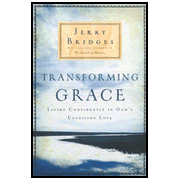
Book Look: Transforming Grace

Transforming Grace – Jerry Bridges

I have recently finished reading this book again.  It was my third time through.  Some authors write their own ideas and attach a few Bible verses.  Others start with Bible verses and move to their own ideas.  Few write immersed in Scripture like Bridges does.  In this book, Bridges gives us an in-depth Bible study on God’s grace.  He covers God’s grace in saving us from our sins, his grace that makes us holy, his grace that enables us to serve, and his grace in the midst of trials.  In the context of this blog, it is God’s grace that both enables and motivates us for three passion living.  So grace is an important reality for us to know more and live in more. If you haven’t read this book, pick it up!  If you have have, you might find it useful like I did to read it again.