A Refusal To Let God Be God

Sin is not primarily about breaking rules,
although it results in that;
it is not at bottom about self-centeredness,
although it always is that.
It is at bottom a refusal to let God be God over life,
to give him the center, the focus,
the glory that are his.

– David Wells

Tinkering with the Church

GodInTheWastelandIt is one of the remarkable features of contemporary church life that so many are attempting to heal the church by tinkering with its structures, its services, its public face. This is clear evidence that modernity has successfully palmed off one of its great deceits on us, convincing us that God himself is secondary to organization and image, that the church’s health lies in its flow charts, its convenience, and its offerings rather than in its inner life, its spiritual authenticity, the toughness of its moral intentions, its understanding of what it means to have God’s Word in this world.

– David Wells in God in the Wasteland

All We Really Need To Know

GodInTheWastelandThe fact is, of course, that the New Testament never promises anyone a life of psychological wholeness or offers a guarantee of the consumer’s satisfaction with Christ. To the contrary, it offers the prospect of indignities, loss, damage, disease, and pain. The faithful in Scripture were scorned, beaten, imprisoned, shipwrecked, and executed. The gospel offers no promise that contemporary believers will be spared these experiences, that they will be able to settle down to the sanitized comfort of an inner life freed of stresses, pains, and ambiguities; it simply promises that through Christ, God will walk with us in all the dark places of life, that he has the power and the will to invest his promises with reality, and that even the shadows are made to serve his glory and our best interests. A therapeutic culture will be inclined to view such promises as something of a disappointment; those who understand that reality is at heart moral because God is centrally holy will be satisfied that this is all they really need to know.

– David Wells in God in the Wasteland

The Fundamental Problem

GodInTheWastelandThe fundamental problem in the evangelical world today
is that God rests too inconsequentially upon the church.
His truth is too distant, his grace is too ordinary,
his judgment is too benign, his gospel is too easy,
and his Christ is too common.

– David Wells in God in the Wasteland

In The Womb Of The Self

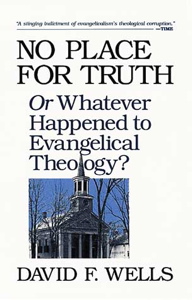
NoPlaceForTruthThe sort of Christian faith that is conceived in the womb of the self
is quite different from the historic Christian faith.
It is a smaller thing,
shrunken in its ability to understand the world and to stand up in it.
The self is a canvas too narrow, too cramped,
to contain the largeness of Christian truth.
Where the self circumscribes the significance of Christian faith,
good and evil are reduced to a sense of well-being or its absence,
God’s place in the world is reduced to the domain of private consciousness,
his external acts of redemption are trimmed to fit the experience of personal salvation,

his providence in the world diminishes to whatever is necessary to ensure one’s having a good day,
his Word becomes intuition,
and conviction fades into evanescent opinion.
Theology becomes therapy,
and all the telltale symptoms of the therapeutic model of faith begin to surface.
The biblical interest in righteousness is replaced by a search for happiness,
holiness by wholeness,
truth by feeling,
ethics by feeling good about one’s self.
The world shrinks to the range of personal circumstances;
the community of faith shrinks to a circle of personal friends.
The past recedes. The Church recedes. The world recedes.
All that remains is the self.

– David Wells in No Place For Truth

Good or Bad Theology

NoPlaceForTruthThe question at issue, then, is not whether we will have a theology but whether it will be a good or bad one, whether we will become conscious of our thinking process or not, and, more particularly, whether we will learn to bring all of our thoughts into obedience to Christ or not.

– David Wells in No Place For Truth

What Sin Is

Sin is not primarily about breaking rules,
although it results in that;
it is not at bottom about self-centeredness,
although it always is that. 
It is at bottom a refusal to let God be God over life,
to give him the center, the focus, the glory that are his.
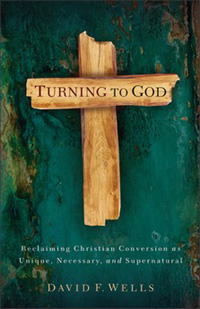
– David F. Wells in Turning To God

The Need To Hate Sin

The Puritans (and their admirers, past and present) actually maintained that only one who has come thoroughly to hate sin can turn wholeheartedly from it to Christ.  Contrition is necessitated not by the terms of the gospel, which calls us to Christ directly, but by the state of the fallen human heart.  God uses the law to pave the way for the gospel by making us see not our only guilt but also the ugliness, nastiness, and repulsiveness of our previous ways, so that we cease to love them; and that sets us free to love Christ when he calls us to follow him into different ways.
– David Wells in Turning To God

Conversion Does Not Stand Alone

Conversion does not stand alone; it is the beginning of a lifelong journey of growing in Christ and being conformed to his image.  Discipleship must follow on conversion as living and breathing follow on birth.

The goal of conversion is nothing less than loving God with all one’s will, emotions, and thinking, whereas previously all of these faculties were engaged in self-love.

– David Wells in Turning to God