Prayer Quotes To Ponder

True prayer is an approach of the soul by the Spirit of God to the throne of God.
– Charles Spurgeon

Prayer is a sincere, sensible, affectionate pouring out of the heart or soul to God through Christ, in the strength and assistance of the Holy Spirit, for such things as God hath promised, or according to the Word, for the good of the church, with submission, in Faith, to the will of God
– John Bunyan

 The Spirit, as an enlightening Spirit, teaches us what to pray for, as a sanctifying Spirit works and excites praying graces, as a comforting Spirit silences our fears, and helps us over all our discouragements.  The Holy Spirit is the spring of all our desires and breathings toward God.
– Matthew Henry

My lack of fervor is no reason to rein in my prayers.  As I pray so weakly, the Holy Spirit strongly pleads for me with groans deeper than I can express to touch the heart of the Father.  And the Father, who sent his Son and his Spirit to be our advocates, loves to listen – and respond.
– Bryan Chapell

The fervor of the Holy Spirit makes my prayers dear to the Father and the power of the Holy Spirit conforms my prayers to his design.  These truths are amazing and comforting.  Because the Spirit works through my prayers to do his will, I do not have to know all the answers or emote just the right feeling for God to use me.  I do not have to say everything right or do everything right to have all things turn out right.  The Spirit takes these burdens from me.  The Holy Spirit uses fallible prayers offered in faith to accomplish God’s perfect will.
– Bryan Chapell

Praying Together: Our Excuses

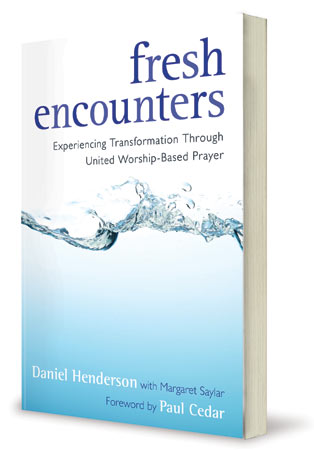
Last week I wrote about God’s expectation that we pray together.  Today I want to address some of our excuses.  Some I have heard from others.  Others I found in Daniel Henderson’s book Fresh Encounters – to which I am indebted to for helping me think through corporate prayer more clearly (see my brief review of the book here).  So here are seven excuses we use to avoid praying together.

1. We are only supposed to pray privately.  This excuse stems from a misunderstanding of Matthew 6:5-6 which says:

And when you pray, you must not be like the hypocrites. For they love to stand and pray in the synagogues and at the street corners, that they may be seen by others. Truly, I say to you, they have received their reward. But when you pray, go into your room and shut the door and pray to your Father who is in secret. And your Father who sees in secret will reward you.

The misunderstanding is that Jesus only wants us to pray privately in our room (or KJV: our closet).  But the issue Jesus is addressing is not so much where we pray as our motive for prayer.  Are we praying to be seen by others (to impress them with our godliness) or are we praying to be heard by God.  And there is a world of difference between giving a “prayer show” out in public and meeting together with other believers to pray together in a room. 

And by the way, we are talking about a room, not a modern closet.  When the KJV was translated, a closet was not a place to store your clothes, but a room.  We can see this from old castles that have large rooms called the King’s Closet (see picture below from Windsor Castle).  A KJV closet had plenty of space for many believers to gather for prayer.

Finally, that Jesus leaves ample room for us to meet not only alone in a room, but also with other believers is clear from the fact that Jesus goes on to teach the disciples a pattern for corporate prayer in v9-13 (see last post). 

2. Praying privately is just as good as praying together.  In other words, the excuse is that we can just stay home and pray on our own instead of gathering together to pray.  Certainly there is some truth here.  We can and should pray privately.  But that doesn’t excuse us from praying together.  The two are not the same.  For instance in Matthew 18:18-20, Jesus speaks of two or three gathering in his name, and he is there in their midst.  Of course he is present everywhere, so the implication seems to be that he is present in some different way than when we pray alone.  Praying together is simply different than praying alone, and we cannot neglect either one.

3. Praying together is boring.  Many people find a few people leading in long prayers with long lists of requests to be rather boring.  But praying together shouldn’t be boring.  Communion with God shouldn’t be boring.  The problem may be our approach rather than the act.  What if we infused Scripture and praise into our times of prayer?  What if we prayed shorter prayers so more people could lead?  The problem is not praying together, but how we do it.  That said, the problem may also be in our hearts.  Do we come with anticipation of spending time together before the Lord?  Or do we come with bad attitudes.  Even an amusement park can be boring if we go with a bad attitude.

4. Praying together is just a gossip session.  Certainly a request-driven prayer meeting can devolve into this.  But we can (and should) guard against it.  Keeping the “share” time short and the prayer time long can help.  Being careful to only pray for things which are public knowledge or that we have permission to share will also help.  At any rate, rejecting corporate prayer because there is the danger of gossip, is like proverbially throwing out the baby with the bath water.

5. No one else is doing it.  This excuse is self-perpetuating.  I don’t because you don’t, and you don’t because I don’t.  But parents would never allow this excuse to stand from their children (none of my friends go to church, none of my friends are waiting for marriage, none….).  As I have heard often – if you were friends were jumping off a cliff would you follow?  And if we are not praying together, we are in fact jumping off a spiritual cliff.

6. I’m too busy.  Really?  Too busy to spend time with other believers communing with God?  In that case there needs to be a serious rearrangement of priorities.

7. I’m afraid to pray out loud.  This is a real fear for many.  But the fact is, you shouldn’t have to pray out loud.  If you don’t want to lead out loud in prayer, just come and pray along agreeing with those who are leading.  Another way to address this is to move to shorter – one or two sentence – prayers.  While long ten minute prayers may be very intimidating, shorter prayers are much more manageable.  When you feel ready, try a short prayer.  Before you know it, you will be praying out loud regularly.

In the end, all of these are excuses.  The bottom line is that God expects us to pray together.  So let’s deal with our excuses, and commit to pray regularly together.  Who knows what God might do!

Praying Together: God’s Expectation

God expects us to pray together.  Have you ever thought in those terms?  Let’s consider it together.

We’ll start with the teachings of Jesus.  When Jesus gives us a pattern for prayer, he gives a pattern to pray together.  What is typically called the Lord’s Prayer in Matthew 6:9-13 uses the plural pronouns our and us throughout.  We pray together, “Our Father in heaven….”  Certainly we can apply it personally, but it is given as a pattern to pray together.  And if Jesus gives us a pattern for praying together, we must assume he expects us to use it.  He expects us to pray together.

Or consider Matthew 18:19-20:

Again I say to you, if two of you agree on earth about anything they ask, it will be done for them by my Father in heaven. For where two or three are gathered in my name, there am I among them.”

When we gather in Christ’s name, Christ is with us.  As we agree about anything we ask together (again per context in his name; that is, according to his will), the Father will do it. Clearly Jesus expects us to come together for prayer.

Then, let’s consider the instructions of Paul.  Paul gives numerous instructions about prayer.  In our culture of rugged individualism we immediately tend to assume he is speaking of personal prayer.  But we must remember that Paul is writing primarily to churches, not individuals.  And the context often points to a more corporate expectation.

Take for instance Romans 12:12, where we are told to “be constant in prayer.”  We might immediately privatize this exhortation, but the context of verses 3-16 reads like a manual for how the church should function together.  It seems much more likely from the context, that Paul is instructing the gathered church to be constant in prayer. 

Or take Romans 15:30-33:

I appeal to you, brothers, by our Lord Jesus Christ and by the love of the Spirit, to strive together with me in your prayers to God on my behalf, that I may be delivered from the unbelievers in Judea, and that my service for Jerusalem may be acceptable to the saints, so that by God’s will I may come to you with joy and be refreshed in your company. May the God of peace be with you all. Amen.

Paul is again writing to the church, to the brothers – plural.  He wants them to strive together in prayer.  He plans to come to them (the church, not each individual).  He wants God’s peace to be with them all. While we might immediately take from this passage that I should pray for missionaries, I think Paul’s request is that we would pray together for missionaries.

Or again consider I Thessalonians 5:17 – “pray without ceasing.”  We struggle with how to apply it personally.  But the context, again like in Romans 12, is clearly about how the church should function together.  So Paul’s main point is that we as a church should pray together without ceasing.

Finally, Paul writes to Timothy.  Here he writes to an individual.  But Paul is not instructing Timothy about how to live his personal Christian life.  No, he is instructing Timothy about how the church to function.  And so he instructs Timothy in 2:1-2 –

First of all, then, I urge that supplications, prayers, intercessions, and thanksgivings be made for all people, for kings and all who are in high positions, that we may lead a peaceful and quiet life, godly and dignified in every way.

Notice – first of all.  This praying together as a church is to be a priority.  And not for my personal good, but for the good of the church together – that we may lead a peaceful and quiet life.  And if there is any question that Paul is speaking of praying together, verse 8 removes it:

I desire then that in every place the men should pray, lifting holy hands without anger or quarreling.

Those last four words make clear that we are talking about praying together.  We are to pray together without anger or quarreling with one another.  We are to pray together with united hearts.  Indeed it would be very difficult to pray together with divided hearts, so praying together regularly forces us to address any divisions among us.

From all these passages, it becomes clear that Paul expects us to pray together, just like Jesus does.

Finally, let’s consider the New Testament’s description of the church as a family.  God is our Father.  We are his children, and brothers and sisters together.  Now what would you think if I told you that my kids play together, and come individually to me, but they never come to me together.  Would that not be strange?  So would it not be strange for us to fellowship with other believers, and individually come to God in prayer, but not come together in prayer?  Indeed John makes this clear in I John 1:3 –

That which we have seen and heard we proclaim also to you, so that you too may have fellowship with us; and indeed our fellowship is with the Father and with his Son Jesus Christ.

We have fellowship with each other, and we have fellowship together (our fellowship) with God.  And certainly this must include God’s children talking together with their Father.  The picture of the church as a family points to the expectation that we will pray together.

So whether we look at the teachings of Jesus, the instructions of Paul, or the church as a family, the clear expectation is that we will pray together.  Now if God expects us to do something, and we don’t do it, what is that called?  It is sin, right?  We don’t want to say that.  It makes us uncomfortable.  It means that our neglect in this area is more than a preference, it is a moral issue.  If we neglect praying together, we sin against God who expects us pray together.  This is serious.  For those neglecting prayer together, it requires repentance – both as individuals and as local churches.  We need to turn from our neglect, and recommit ourselves to gather regularly with God’s people for prayer.  It means churches must get serious about that neglected prayer meeting.  It means we need to start living out God’s expectation that we pray together.

Father, thank you for Jesus who died to pay for all of our sins, including our neglect to pray together.  Forgive us for this sin, and change our hearts to desire what you desire.  Grant us a desire to pray with your people. And may we from this day forward change to be the people you want us to be – a people that pray together to you.  Amen.

Prayer Quotes To Ponder

In our culture of rugged individualism we have come to the conclusion that it is better to pray alone than with others.  Unfortunately, most of us never learn to do either one very well.  Like most disciplines of the Christian faith, we learn best to pray alone when we have been taught in community.
– Daniel Henderson

 Praying together provides an education in prayer for the entire church.
– Joel R. Beeke

 We shall never see much change for the better in our churches in general till the prayer meeting occupies a higher place in the esteem of Christians.
– Charles Spurgeon

 If congregational or small group prayer isn’t part of your Christian life, there’s a problem.  Private-only prayer is not New Testament Christianity.  Prayer with others from the body of believers was one of the four marks of the church in Acts 2:42.  Some say they don’t pray with groups because they are too self-conscious when praying aloud with others.  This verse doesn’t say they all prayed aloud, but it does mean that they prayed together.  If you are unwilling to pray with others, you are too independent spiritually.
– Donald Whitney

 A congregation without a prayer meeting is essentially defective in its organization, and so must be limited in its efficiency.
– J. B. Johnston

 Praying regularly with others can be one of the most enriching adventures of your Christian life.  Most of the great movements of God can be traced to a small group of people He called together to begin praying.
– Donald Whitney

Book Look: Fresh Encounters

Fresh Encounters by Daniel Henderson is an articulate and passionate call for the church to come back to corporate prayer.  Henderson answers common misconceptions about corporate prayer and shows how corporate prayer is both the expectation of the New Testament and the example of the early church.  Yet his call is not to some boring long-winded prayer meeting for endless requests.  Rather, he maps out his vision for a more God-centered worship-based time of prayer.  And he shows church leaders how to move to a greater prayer emphasis in the church, complete with numerous corporate prayer plans and ideas.  Highly recommended.

Prayer Convictions

What are the convictions of a praying leader, a praying believer, and a praying church?  In summary:

  • God is worthy, far beyond the attraction of anything this world offers.
  • I am needy, in spite of my apparent self-sufficiency and earthly prosperity.
  • Jesus Christ invites me to seek Him and will empower me by His grace to endure in my pursuit.
  • Jesus longs for His church to be a house of prayer, and I will faithfully contribute to that vision.
  • Jesus’ glory in and through the church to the world will be my determined passion.
  • God is a rewarder of those who seek Him diligently.

 – Daniel Henderson

Praying in Community

In our culture of rugged individualism we have come to the conclusion that it is better to pray alone than with others.  Unfortunately, most of us never learn to do either one very well.  Like most disciplines of the Christian faith, we learn best to pray alone when we have been taught in community….We need to create a new sense of community in prayer to help people rise above their individualistic bent.

– Daniel Henderson

Passion Points

Here are some suggested posts for your pondering pleasure this weekend:

First, some good posts on prayer.  Stephen Altrogge encourages us to not lose our intensity in prayer, while Mark Altrogge encourages us to pray expectantly.  Meanwhile my friend Mike at Hunger and Thirst has a great post on how trusting God’s promises needs to impact our prayers.  And Trevin Wax fleshes out the Lord’s Prayer with related Scriptures.

Meanwhile, on other topics:

Finally, the quote of the week comes from J.I. Packer via Justin Taylor addressing our lack of focus on communion with God.  Read this quote – and let it impact your life!

Book Look: A Praying Life

A Praying Life – Paul Miller

How does prayer and life intersect?  This book helps answer that question.  Miller takes Biblical principles and shows how they have intersected with his family life.  This dual approach anchors the book in truth while also making it practical and encouraging – a greater prayer life is not beyond our reach. 

He begins by helping us see that we are helpless – and hence must pray.  Our problem is that we think we can do life on our own – and so we don’t pray.  He then explores the need to trust God so that we will pray.  If I don’t trust God, I simply won’t bother with prayer (why would I pray if I can’t trust him?).  Both our helplessness and his trustworthiness were ideas I needed to wrestle with and grasp onto, and I suspect others would benefit from his exploration of these foundational topics as well.  He continues by considering our requests, and helping us to see how prayer and our daily life fits into God’s bigger story.  Finally, he suggests some practical ideas (like using prayer cards and a prayer journal) to help us grow in prayer.  Recommended.