Passion Points – Valentine’s Day

Being Valentine’s Day, I thought I’d pass on some helpful links on love and marriage:

Love:  Paul David Tripp unpacks what love really looks like.  Do we love people like this?

Marriage: Tripp discusses the important place of worship in marriage.  Gary and Betsy Ricucci show the difference between pride and humility in marriage, and consider how the gospel changes our marriages.

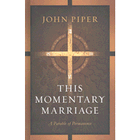
Book Look: This Momentary Marriage

This Momentary Marriage – John Piper

I’ve already mentioned in past posts how helpful this book was in helping me think through what it means to have a gospel shaped marriage.  Christ’s passion for us should affect our marriages.  The book also tackles being single and the issue of divorce.  Recommended.

Click here for other posts about the family.

Now Marriage Is A Picture

Now Marriage Is A Picture

The Church’s one foundation, is Jesus Christ her Lord
She is His new creation, by water and the Word
From heaven He came and sought her, to be His holy bride
With His own blood He bought her, and for her life He died.

Now marriage is a picture, of Jesus and his bride
May our vows remain secure, may we in love abide
For Christ will never leave us, forsake us never he
As he is faithful to us, so faithful we must be

May sacrificial giving, be in our homes today
And true humble forgiving, and grace in all we say
For Jesus died to save us, forgive those gone astray
He pours his grace upon us, with more grace every day

Each husband love his own wife, and leading for her best
As Jesus gave his own life, to give us hope and rest
Each wife respect her husband, and joyfully submit
As we before the Lord stand, and gladly do commit

May each and every marriage, shaped by the gospel be
Forsake the gods of this age, worship the Lord only
All praises we would give you, for all that you have done
Forever we’ll adore you, Great God the Three in One

(First verse by Samuel J. Stone from the hymn The Church’s One Foundation, to the same tune by Samuel S. Wesley, Public Domain.  I wrote verses 2-5 to go with the Gospel Shaped Marriage sermon which I just blogged.  All rights reserved.  Copyright 2010.)

Gospel Shaped Marriage 4

Marriage is based on the gospel and is a picture of the gospel, so our marriages must be shaped by the gospel.  In the last two posts, we noted that this happens as we sacrificially give of ourselves and as we commit to grow in holiness.  Now we’ll look at two final aspects of a gospel shaped marriage, and then conclude our reflections.

First, a gospel shaped marriage has a firm grip.  The gospel makes clear that Christ has a firm grip on his church.  He will not divorce his church.  He will not get tired of his church.  The marriage supper of the lamb is certain.  Our spending eternity with him is certain.  Now if marriage is based on the gospel and is a picture of the gospel, we must have a firm grip on one another in marriage.  If Christ will not divorce his church, then we cannot divorce each other.  If marriage pictures the gospel, then divorce distorts the picture.  So we must have a firm grip on one another.  Not a loose grip, not a slow drifting apart, but a firm grip.  We must guard our marriages lest we distort the picture of the gospel by divorce.

Second, a gospel shaped marriage includes forgiving grace.  In Ephesians 4:31-32 we see the gospel in the last phrase: “as God in Christ forgave you.”  God has forgiven us through Christ.  Every sin is buried forever, never to be dug up and used against us.  Now if marriage is a picture of the gospel, then we must forgive one another.  Past sins must be buried and remain buried, never to be dug up and used against the other person.  In the gospel, we find that God has poured out his grace on us – even though we don’t deserve it.  In a gospel shaped marriage, we must share that grace with our spouse – even when he or she doesn’t deserve it.  It isn’t about deserving – it is about grace, it’s about a gospel shaped marriage.

Our culture sometimes whispers, sometimes shouts its low distorted view of marriage.  In the midst of the onslaught, let us take our stand on a high true view of marriage.  Marriage is based on the gospel and is a picture of the gospel.  So let us sacrificially give of ourselves.  Let us be committed to growing in holiness.  Let us have a firm grip on our spouse.  Let us extend grace and forgiveness.  Let us live gospel shaped marriages.

And when death comes, our marriages will end.  The picture of the gospel will be finished, but the gospel that our marriages picture will go on.  When Christ returns, we’ll celebrate the marriage supper of the lamb.  And new joys will expand forever and ever with the Lord.  Even so, come Lord Jesus.

Gospel Shaped Marriage 3

Marriage is based on the Christ/church relationship and pictures the Christ/church relationship.  Marriage is closely connected to the gospel.  That means my question – how should the gospel shape our marriages? – is not incidental but essential.  The gospel must shape our marriages because our marriages are based on the gospel and point to the gospel.  So how should the gospel shape our marriages?

In the last post we noted that our marriages should have a sacrificial giving of ourselves to each other – as Christ sacrificially gave of himself for the church, and the church sacrificially submits itself to Christ.  Now we want to consider a second way that the gospel should shape our marriages – a commitment to grow in holiness.

In Ephesians 5:25-27, we find that Christ sacrificially gave of himself to make the church holy.  “In the same way husbands should love their wives…” (v28).  As Christ makes the church holy, so husbands should seek the holiness of their wives.  A husband’s leadership (see last post) includes spiritual leading as he seeks to help his wife grow in holiness.  Men, are we doing this?  Are we encouraging our wives in their daily time with the Lord?  Are we taking them to church, and leading them to serve in the church?  Are we praying for them and with them?  Are we leading our wives to grow in holiness?

What about wives?  Can they help their husbands grow in holiness?  At first look, the answer might be no.  The church does not help Christ grow in holiness, so the wife should not help her husband grow in holiness.  But we need to understand that, while the husband is patterned after Christ, he is not Christ.  Christ was sinless, husbands are not.  (If any men have any doubts about this, ask your wife, and she will clear it up for you!)  Husbands need to grow in holiness.  So it would seem that wives could encourage their husbands to grow.  Not nag.  Not try to lead.  But gently encourage their husbands.

Yet marriage is more than just helping each other grow.  Marriage itself is a laboratory for growth.  The gospel reminds us that Christ gave of himself (v25).  He humbled himself unto death (Philippians 2:8).  And part of our response is to deny ourselves, take up our cross, and follow him (Matthew 16:24).  An important part of growth is this self-denial, this humbling, this giving of ourselves – this becoming like Jesus.  This means that marriage is a great context for growth because a huge part of marriage is a sacrificial giving of ourselves (see last post).  If we commit to the sacrificial roles God designed for us, we will grow more like Christ, we will grow in holiness.

So marriage is based on the gospel and is a picture of the gospel.  Our marriages must be shaped by the gospel.  This happens as we sacrificially give of ourselves and commit to grow in holiness.  We will look at two final aspects of a gospel shaped marriage in the next post.

Gospel Shaped Marriage 2

To recap from the last post:  marriage is based on the Christ/church relationship and pictures the Christ/church relationship.  Marriage is closely connected to the gospel.  That means my question – how should the gospel shape our marriages? – is not incidental but essential.  The gospel must shape our marriages because our marriages are based on the gospel and point to the gospel.  So how should the gospel shape our marriages?

First, there is to be a sacrificial giving of ourselves.  Let’s start with husbands, whose role is based on Christ.  Christ sacrificially loved the church, giving of himself for the good of the church.  So the husband is to sacrificially love his wife, giving of himself for the good of his wife.  Christ nourishes and cherishes (takes care of) his church.  So the husband is to nourish and cherish his wife, providing for her needs.  Christ is the head of the church, providing leadership for the church.  So the husband is the head of the wife, providing leadership for the family.

This latter point of course irritates many people.  But we must see it in the context of what we said before.  This leadership is sacrificial, seeking the wife’s best, and providing for the wife.  There is no room for self-centered demands in this leadership.  It is a sacrificial giving of the husband for his wife.  This is a gospel shaped marriage.

Then wives too are to sacrificially give of themselves.  This is done through submission to the husband.  This too irritates many people.  Some want to argue that Paul is stuck in his own culture, and this is the twenty first century!  But notice again Paul’s statement is based on the Christ/church relationship.  If marriage is based on and pictures the gospel, the wife must submit to her husband as the church submits to Christ.  But this is degrading to women many might say.  But dear church – do you feel degraded because you are called to submit to Christ?  No?  So submission need not be degrading.  Jesus says that if we love him we will obey him (John 14:15).  So the church submits to Christ out of love.  And so the wife can submit to her husband out of love.  As the church cheerfully, joyfully, freely submits to Christ, so can the wife submit to her husband.  This indeed requires a sacrificial giving of herself, but in doing it she points to the gospel.  This is a gospel shaped marriage.

So a gospel shaped marriage acknowledges different roles for the husband and the wife based on the roles of Christ and the church.  Both of these roles flow out of a sacrificial giving of ourselves.  We’ll consider further aspects of a gospel shaped marriage in the next post.

Gospel Shaped Marriage

Our culture has a low distorted view of marriage.  This is not news.   The high divorce rate, the thousands living together outside of marriage, the media’s portrayal of marriage, the attempt to redefine marriage, and the frothy romantic feelings many base marriage on – all point to a low distorted view of marriage.  In the midst of this mess, the church needs a renewed vision of marriage, a high view, a real view, a Biblical view.

To find such a view, we could turn back to creation.  We could see that God designed marriage between a man and a woman, that he designed sex for the safety of a loving committed marriage relationship, and that he designed marriage to be a lasting commitment.  But by and large the church knows these things, so I want to look at marriage from a different vantage point.  I want to consider marriage not in the context of creation, but in the context of salvation.

I want to ask: how should the gospel shape our marriages?  Ever asked that question?  Ever even consider that there might be a connection?  Let’s begin by exploring the connection:

Read Ephesians 5:22-33.  What is this passage about?  The marriage relationship?  The Christ/church relationship?  Both?  Indeed both.  Paul weaves the two together throughout the passage.

Looking closer, we notice that the husband’s role is based on Christ’s role: “the husband is the head…even as Christ is the head….husbands love your wives as Christ loved the Church.”  Similarly the wife’s role is based on the church’s role: “as the church submits…so also wives should submit.”  The marriage relationship then is based on the Christ/church relationship.

Look at verses 31-32.  Verse 31 quotes Genesis 2 which is speaking of marriage.  Yet verse 32 says it (the marriage relationship) refers to Christ and the church.  That is, the marriage relationship points to or pictures the Christ/church relationship.  Our marriages are a picture of Christ and his church.  Marriage is a picture of the gospel.

So marriage is based on the Christ/church relationship and pictures the Christ/church relationship.*  Marriage is closely connected to the gospel.  That means my question – how should the gospel shape our marriages? – is not incidental but essential.  The gospel must shape our marriages because our marriages are based on the gospel and point to the gospel.  We’ll look at specific ways the gospel should shape our marriages in the next post.

*I am indebted to John Piper’s book This Momentary Marriage for the insight that marriage is based on and pictures the Christ/church relationship.  I recommend the book to you.