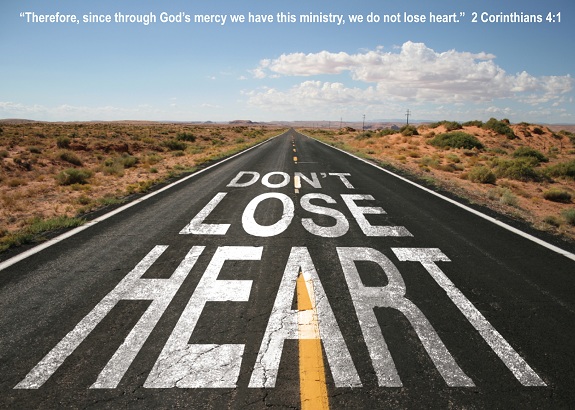
Don’t Lose Heart

A few weeks ago I mentioned a pastor’s conference I attended.  The sessions are now available on audio here.

The two sessions by Jim Grier would be great for any Christian who wants to think.  In the first session he gives a helpful overview of God’s presence throughout the Bible.  In the second, he paints the picture of God’s presence as we gather to worship from Hebrews 12:18-29.  You may never approach worship the same!  Highly recommended!

And if you are a weary pastor, there are some great messages of encouragement for you by Joel Beeke from Hebrews 12:1-3 and Steven Lawson from II Corinthians 4.  Beeke also shares some lessons on perseverance from the lives of John Calvin and John Bunyan.

Coming To Worship

At the Pastor’s Conference I attended last week, Jim Grier discussed worship from Hebrews 12:18-29.  A few highlights to ponder as you prepare to gather with God’s people this Sunday to worship God:

As we gather for worship, we come into the very presence of our God.

It doesn’t matter if the worship is acceptable to us, but if it is acceptable to God.

Acceptable worship is worship with careful reverence, awe-filled fear, and incredible joy.

I wonder how different our Worship Services would be if we could just grasp and live out these three principles.

How To Prepare for Worship

Sunday is coming.  The day when you gather together with other believers to worship God.  Have you ever considered the importance of preparing?  What would it look like to prepare for worship?  A couple of suggestions:

First, get a good night’s sleep.  If you stay up until all hours of the night, it is no wonder you are groggy during the service and struggling to stay awake during the sermon.  God deserves our best.  Get enough sleep so you will be alert and able to give your all.

Second, deal with your sins.  Examine your life.  Are there sins you need to confess to the Lord?  Sin hurts our fellowship with God; deal with them so you can worship God without hindrance.

Third, preview the passage you will be studying together.  If your pastor is working through a book of the Bible, this should be relatively easy.  If not, ask your pastor if he can put the next Sunday’s passage in the bulletin. Reading and pondering the passage ahead of time will prepare you to hear the message.  (It is also a great help for your children, but that is another post.)

Fourth, pray.  Pray that God would speak to you.  Ask God to help you praise him as you should.  Ask him to help you encourage others.  Pray for the pastor, teachers, ushers, musicians, nursery workers, etc.  If possible, meet with some others before the service to pray together for God to work among you.

Fifth, come with expectation.  Come eager to hear the Word.  Come excited to sing praises to God.  Come cheerfully to give your gifts to the Lord.  Come ready to build up others and serve.  Come with expectation of what God might do in you and through you.

Remember that these are suggestions, not laws.  I don’t do all of them every week.  Sometimes some of them just aren’t possible.  But they can help us come ready to worship.  Imagine if we all came ready to worship God together!   Let it begin with you.

How will you prepare for worship this weekend?

Passion Points

Wow, there are a lot of good posts from around the web for your weekend reading.

First, let’s consider the important matter of salvation.  How do you know you are saved?  At issue here is the danger that many people have a false assurance of salvation.  To help us think through this and examine ourselves, Mike McKinley suggests five things that all Christians have.  He also addresses the important issues of perseverance and preservation.  And then Tim Challies suggests three statements on assurance, and reminds us of where our assurance lies.

Second, Kevin DeYoung addresses our tendency to get excited about minor issue instead of focusing on the core doctrines.

Third, Mark Altrogge reminds us that faith is like a power cord that plugs into God’s power as we pray.  Faith in itself has no power (despite the many songs proclaiming all that faith can do).  The power is found in the object of our faith.  So the strength of our faith is not so much the issue as the strength of the one we place our faith in.  God can use our flimsy faith.

Fourth, here are a couple of good ideas for evangelism.  Tim Chester suggests using meals for evangelism, while Brian Croft suggests asking people about the sermon they heard on Sunday as a way for evangelism. (Don’t knock it until you read the post!)

Fifth, Stephen Altrogge helps us cut the nerve of complaining.

Finally, Kevin DeYoung suggests 10 principles for church singing – Part One and Part Two – that you might consider before going to worship on Sunday.  It will help you think about what you are going to do even if you don’t agree with every point (and I will have to at least disagree with his preference for organs!).

Have a great Lord’s Day worshipping with your church family!

Passion Points

Hi all!  A few good reads for the weekend:

First, what do you do when you are struggling with your faith, or trials seem to be shredding your faith?  How do you get your faith back?  How do you press forward in your faith?   Mark Altrogge has some wise words to guide us.

Second, let’s think about worship.  Better yet, let’s prepare for gathering to worship with our church family tomorrow.  Bob Kauflin gives us three good reasons to sing in church.  And Mark Altrogge reminds us that the words matter.

Third, as we prepare for Passion Week, Ray Ortlund gives us a helpful quote from John Stott on one way the cross changes us.

Hope you have a great Lord’s Day building your faith, worshipping the Lord, and reflecting on your Savior!

Better Than Life

Because your steadfast love is better than life,
my lips will praise you.
– Psalm 63:3

Because your steadfast love…
Your help
Your strength
Your comfort
Your blessing
Your sustaining
Your sacrifice
Your forgiveness
Your salvation
Your promises

…is better than life…
Money
Things
Job
Vacations
Recreation
Entertainment
Internet
Sleep
Food
Popularity
Status
Friends
Family
Health

…my lips will praise you.
Celebrate you
Sing of you
Honor you
Glorify you
Tell of you

Amen.

What Ever Happened To The Hymns?

I have been teaching a class on the Great Awakening for some teens from Christian families in our area.  This last week, we looked at Charles Wesley.  I gave them a list of some of his hymns and asked how many they were familiar with.  Even after exploring some of the titles, the most any of them recognized was four.  Four!  Here are some of the titles from the list:

A Charge to Keep I Have
And Can It Be that I Should Gain
Christ the Lord Is Risen Today
Come, Holy Ghost, Our Hearts Inspire
Come, Thou Long-Expected Jesus
Depth of Mercy
Hail The Day That Sees Him Rise
Hark! the Herald Angels Sing
Jesus, Lover of My Soul
Lo, He Comes with Clouds Descending
Love Divine, All Loves Excelling
O For a Heart to Praise My God
O For a Thousand Tongues to Sing
Rejoice, the Lord Is King

Most were not familiar with And Can It Be or For A Thousand Tongues To Sing.  I suppose I shouldn’t be surprised.  I know many churches no longer sing hymns.  And yet, I found their ignorance of even the most well-known hymns incredibly depressing.  We are losing our Christian heritage.  The church I grew up in really never taught about the history of the church, but at least I had the great hymns.  Many of the next generation don’t even have that anymore.

I’m not here to knock new choruses and hymns.  There are some great new songs worth learning and singing for the rest of our lives. But there is a place for the old hymns too, for at least the following reasons:

1. The hymns connect us to our heritage, reminding us that we are part of something bigger than just today.  The church didn’t start in my generation; it has been here for 2000 years, and the hymns help us connect with the wisdom of those who have gone before us.

2. Many hymns have incredible theological depth.  In an age of theological shallowness and downright ignorance in the church, we  need all the help we can get to teach the doctrines of the faith.

3. Many of the hymns have incredible experiental depth.  They are not passionless theological treatises, but passionate responses to who God is, what he has done, and what he has yet to do.  Many of the hymn writers had an experiential walk with God that puts ours to shame.  We need to be reminded that our lukewarm state is not normal.

4. Over time, the best hymns have been passed on, while most of the chaff has fallen away.  Wesley wrote 9000 hymns, yet we only sing a fraction of what he wrote. (I’ve read some of the hymns that rightly didn’t make the cut!)  Perhaps there are some jems that over time were overlooked and lost.  Undoubtedly there are some inferior songs that have somehow been passed on.  But overall the old hymns in our hymnals today are the best of the best.  Undoubtedly there are some new songs that will likewise stand the test of time and be sung down through the ages, but many will fall away like chaff.

5. We need to sing the same songs year after year so that we might memorize them.  As we learn them, they can over time form us.  Even more they can encourage us in times of trouble.  And should our memories start to go in old age, those hymns we learned as children and sang all of our lives have incredible staying power.  I distinctly remember my grandpa advanced with Alzheimer’s disease unable to remember much of anything but yet able to sing many of the old hymns from memory.  And many have told me of similar experiences in older folks that they have known.  What about the next generation that never sang a song more than two months before the moving on to the next great hit?

With all of the above in mind, I want to do my part to encourage the continued use of the old hymns.  That means, among other things, that I am starting a new feature on this blog.  I want to regularly feature a great hymn of the faith.  Each feature will include the words, a link to the music, some commentary, and when possible some history behind the hymn.  Stay tuned!

The Coming of the Spirit 4

The Spirit comes and not only makes us part of his church, empowering us to minister and witness, but he also dwells among us.  I Corinthians 3:16 remind us that the church is God’s temple where his Spirit dwells.  As we gather together, the Spirit of God is among us.

Do we gather ready to enter his presence?  Are we even aware as we gather that God is with us?  How often are we like a poor host who neglects his guest?

The church is God’s temple where the Spirit dwells.  Temples are places of worship.  Do we gather not only recognizing his presence, but also ready to worship?  To submit our lives to his Word?  To bring our gifts to him?  To bring our cares before his throne?  To praise and honor him with our songs and our hearts?

The Spirit has come and dwells in his church.  As we gather, let us recognize his presence, bow down, and worship.

Humble Worship

There was a lady named Anna.  She had been a widow for many years.  She did not depart from the temple, but worshiped God with prayer and fasting night and day.  Night and day.  24/7.  Continuously.  Constantly.  This speaks volumes about her heart…and ours.  How many of us can see ourselves doing this?  Her heart must have been ablaze with love and adoration toward God to sustain this constant humble worship.

Do we approach each day as an opportunity to worship God? To spend time with God in praise and prayer?  As we awake?  On the road?  In our spare moments?  As we go to sleep?  Even in the midst of many tasks, we can praise God and pray – do we?  Most of us can’t focus exclusively on worship like Anna did – we have families and jobs.  Yet even those activities can be offered up to God as worship – honoring him, serving him.

Are you ready to offer humble worship to God today?

(Luke 2:36-38)

Gospel Shaped Suffering 4

How should the gospel shape our suffering?  We have looked at six ways already.  Let’s look at two final ways today.

Bearing Witness to Christ (Evangelism)

We receive the gospel by faith, but how will people hear the gospel unless we bear witness to Christ?  Suffering offers us a powerful platform to share the work of Christ in our lives.  Several people in my church have shared how they have had opportunities to tell others about Christ in the midst of their suffering.  There are records from the early church of people who witnessed the suffering and death of Christian martyrs and were saved as a result.  Courage, trust, and hope in trials leaves a lasting impression, a strong witness for Christ.  In fact, sometimes are suffering is for the purpose of bearing witness.  Jesus told his disciples that they would be taken to court, flogged, and dragged before rulers for his sake, “to bear witness before them” (Matthew 10:17-18).  Using our suffering as an opportunity to bear witness to Christ is gospel shaped sufferings.

Counting All as Loss for the Treasure of Christ (Worship)

The gospel is spread through evangelism and received by faith, but what is the goal of the gospel?  The goal is worship.  As John Piper writes in his book on missions, “Missions exists because worship doesn’t.”  We were created to glorify God, but we all sin and fall short of his glory (Romans 3:23).  The gospel exists to save us from our sins and change us back into worshippers who glorify God, worshippers who love God and serve God, who treasure God above all else.

Worshippers like Paul.  In Philippians 3:7-11, Paul says he suffers the loss of all things for Christ.  What is suffering?  Often it is loss – loss of heath, loss of a loved one, loss of comfort, loss of a relationship, loss of a dream.  Paul says he suffer the loss of all things, counts it all as loss.  Why?  Because of the surpassing worth of knowing Jesus.  He will share in the sufferings of Christ because what he wants most of all is Christ.  Gospel shaped suffering means we are willing to suffer loss because in Christ we have the greatest treasure of all.

What is gospel shaped suffering? It is:

  • Following the path of Christ
  • Becoming more like Christ
  • Resting in the love of Christ
  • Rejoicing in the hope of Christ
  • Trusting God like Christ
  • Comforting others in Christ
  • Bearing witness to Christ
  • Counting all as loss for the treasure of Christ

May God help us suffer in this way for his glory.